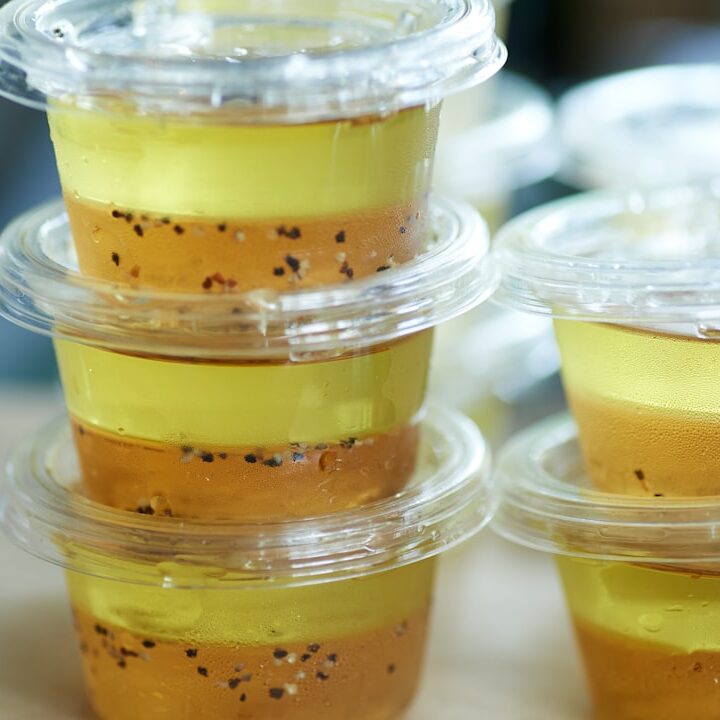
These transportive jellies much more than dessert — they’re edible science experiments that reveal exactly how flavour, texture, and even memory work together on your plate. I’ve spent the last two years obsessing over jellies that do something most desserts won’t: they genuinely transport you somewhere. Not through sugar crashes or saccharine nostalgia, but through deliberate technique and understanding the chemistry that makes gelatin set, release flavour in waves, and create mouthfeel that ranges from barely-there to luxuriously dense.
Table of Contents
The Science Behind Gelatin Setting
Let’s start with the fundamentals. Gelatin is a protein derived from collagen — the structural scaffolding in animal connective tissues. When you add unflavoured gelatin powder (typically 2.5g per packet) to cold water, the granules absorb moisture but don’t dissolve. Heat changes everything. At 40°C (104°F), gelatin begins to hydrate fully, breaking apart. At 65°C (149°F), it becomes completely liquid, individual protein strands unwinding in the warm liquid.
Here’s where it gets interesting: as your jelly cools back down past 10°C (50°F), those protein chains begin bonding with each other in a three-dimensional network, trapping water molecules inside. One 2-gram gelatin leaf (or roughly 1 teaspoon of powder) can set approximately 250ml of liquid. Go below that ratio, and you’ll end up with a wobble that’s more sauce than jelly. Go above it, and your jelly becomes rubbery — I’ve seen this happen to countless first-timers who dump in extra gelatin, thinking more equals better.
The bloom strength of gelatin matters too. Gold leaf gelatin (225 bloom) is stronger than silver (160 bloom), meaning you need less to achieve the same set. Most home cooks have access to silver leaf or powdered gelatin, which is fine — just know your ratio and stick to it.
Why These Transportive Jellies Much Work: Flavour Release
Standard jelly tastes flat because flavour molecules are suspended uniformly throughout. They hit your palate all at once, release, and vanish. Not transportive. Real jellies — the ones worth making — release flavour in stages.
Take a passion fruit and elderflower jelly, for example. The initial bite releases the bright, acidic passion fruit top notes (thanks to citric acid and volatile aromatic compounds that dissolve in saliva first). As you chew, the smooth gelatin base dissolves slowly, releasing the deeper floral notes of elderflower — compounds like linalool and geraniol, which are fatter molecules requiring more time and saliva to fully register. By the time you swallow, there’s a lingering finish that your brain associates with the middle taste — neither sharp nor floral, but a blend of both.
This layered release is deliberate. It happens because I’m using a two-layer structure: a passion fruit layer (intense, thin — about 8mm) sitting on top of an elderflower-gelatine base (subtle, thick — about 25mm). Your mouth encounters the sharp layer first, then the soft layer, creating temporal complexity. That’s what makes it transportive. You’re not just eating jelly; you’re experiencing a story.

Temperature Control in These Transportive Jellies Much
Temperature is your primary control variable. Most home cooks ignore this, and it’s the reason their jellies taste muted.
Never boil your liquid before adding gelatin. Boiling volatile aromatic compounds (the ones that carry flavour) off into steam. Instead, heat your liquid to 75–80°C (167–176°F), pour it over gelatin that’s been bloomed in cold water for 5 minutes, stir for 90 seconds until fully dissolved, then let it cool to room temperature (approximately 21–23°C) before pouring into moulds. If you’re layering (essential for transportive jellies), cool each layer to 18–20°C before adding the next one. At this temperature, the new layer won’t melt into the old one, but it’s still warm enough to set smoothly without creating a visible seam.
Chilling time matters too. Don’t rush it. A standard 250ml jelly needs 4 hours at 4°C (40°F) to fully set. Less time, and the protein network hasn’t fully formed — you’ll get wobble instead of structure. More time is fine; jellies stay stable for up to 10 days in the fridge, though after day 5, surface moisture begins to accumulate (evaporation creates a thin skin).
Three Recipes That Prove Jellies Are Serious Food
Recipe 1: Passion Fruit and Elderflower Jelly
Ingredients (serves 4):
- 250ml passion fruit pulp (approximately 6–8 fresh passion fruits, sieved, or 250ml frozen pulp thawed)
- 25ml fresh lime juice
- 10g caster sugar
- 2.5g powdered gelatin (or 1 leaf)
- 30ml cold water
- 200ml elderflower cordial (like Bottlegreen)
- 250ml boiling water
- 7.5g powdered gelatin
- 60ml cold water
Method:
Bloom 2.5g gelatin in 30ml cold water for 5 minutes. Combine passion fruit pulp, lime juice, and caster sugar in a small saucepan. Heat to 75°C (167°F) — use a thermometer, don’t guess. Pour over bloomed gelatin, stir for 90 seconds until clear. Divide between 4 serving glasses (approximately 50ml per glass). Chill for 2 hours at 4°C until just set but still slightly tacky to touch.
While that sets, bloom 7.5g gelatin in 60ml cold water for 5 minutes. Pour boiling water over elderflower cordial (which gives you approximately 200ml liquid), then pour that over bloomed gelatin. Stir for 90 seconds. Cool to 18–20°C — this takes approximately 15–20 minutes at room temperature, or 5 minutes in an ice bath. Carefully pour over the set passion fruit layer (approximately 80ml per glass). Return to fridge for 4 hours until fully set.
Flavour timeline: First bite hits you with sharp passion fruit and lime. By the third or fourth chew, the floral notes emerge. Finish is balanced, neither acidic nor floral — both at once.
Recipe 2: Tomato Water and Basil Jelly
This one surprises people. It’s savoury, delicate, and tastes nothing like standard tomato jelly.
Ingredients (serves 4):
- 500g ripe tomatoes (heirloom varieties work better — higher flavour density)
- 5g sea salt
- 2g caster sugar
- 5ml sherry vinegar
- 7.5g powdered gelatin
- 30ml cold water
- 15 fresh basil leaves (approximately 3g)
- 60ml extra virgin olive oil
Method:
Dice tomatoes, mix with sea salt, and let sit overnight in the fridge. The salt draws out tomato water through osmosis — you’ll get approximately 300ml clear liquid (tomato water). Strain through a fine sieve or coffee filter (takes 2–3 hours; don’t rush it).
Heat tomato water to 75°C. Add sherry vinegar. Bloom gelatin in cold water for 5 minutes, then pour hot tomato water over it. Stir for 90 seconds. Cool to room temperature (approximately 21°C). Bruise basil leaves slightly and divide between 4 serving glasses. Pour jelly over basil (approximately 80ml per glass). Chill for 4 hours. Drizzle each with 15ml olive oil just before serving.
Why this works: Tomato water contains umami compounds (glutamates) at higher concentration than whole tomato juice. The basil adds anise-like top notes. Olive oil coats your palate, slowing flavour release. You get savoury complexity that tastes luxurious, not dessert-like.
Recipe 3: Bergamot Tea and Honey Jelly with Chamomile Cream
Ingredients (serves 4):
- 350ml whole milk
- 100ml double cream
- 3g dried chamomile flowers
- 5g caster sugar
- 3.75g powdered gelatin
- 250ml Earl Grey tea (brewed strong: 2 teabags in 250ml water, steeped 5 minutes)
- 20ml honey (preferably raw)
- 2g powdered gelatin (for the tea layer)
- 15ml cold water
Method:
Heat milk and cream to 75°C. Add chamomile flowers, remove from heat, cover, and steep for 8 minutes. Strain out flowers. Add caster sugar, stir to dissolve. Bloom 3.75g gelatin in 15ml cold water for 5 minutes. Pour hot chamomile cream over gelatin, stir for 90 seconds. Divide between 4 serving glasses (approximately 80ml per glass). Chill for 2 hours until just set.
Brew Earl Grey tea strong (2 teabags per 250ml water, 5-minute steep). While still hot (approximately 75°C), stir in honey. Bloom 2g gelatin in 15ml cold water for 5 minutes. Pour hot tea over gelatin, stir for 90 seconds. Cool to 18–20°C. Carefully pour over chamomile layer (approximately 65ml per glass). Chill for 4 hours.
The experience: You get floral aromatics first (bergamot’s linalool and geraniol), then creamy mouthfeel from the chamomile base, then a lingering honey finish. It’s not dessert; it’s an edible meditation.
Storage and Serving Precision
These jellies last 10 days at 4°C (40°F), but flavour peaks between days 2 and 6. On day 1, the layers haven’t fully bonded — you get separation. By day 7, surface evaporation creates a thin glossy film that affects mouthfeel slightly.
Unmould carefully. Run a thin knife around the inside edge, dip the bottom of the glass or mould in warm water (approximately 35°C) for 10 seconds, and invert onto a plate. The jelly should slide out cleanly. If it doesn’t, you either didn’t set it long enough or your gelatin ratio was off.
Serve at approximately 8–10°C — not straight from the fridge, but cool enough to maintain structure. Room temperature (21°C) softens the jelly and speeds flavour release, which can be desirable if you want intensity. Cold (4°C) slows flavour release, creating a more subtle experience.
One practical tip: Make your jellies in small individual glasses instead of large moulds. You avoid unmoulding entirely, they chill faster (individual portions take 3 hours instead of 4), and presentation is instantly elegant. Plus, you can layer directly in the glass, seeing the final structure as you build it.
Honestly, jellies have a reputation problem. People think they’re outdated, overly sweet, or just vehicles for artificial flavours. That’s because most commercial jellies are exactly that. But when you control temperature, ratio, and flavour release? You’re making something with real depth. Something that actually transports you — whether that’s to a passion fruit grove in Vietnam, a tomato garden in Provence, or a calm afternoon with tea.
Start with one recipe. Master the technique. Then experiment. Your jelly journey starts here.
Explore more on Recipes – Scope Digest and browse our Desserts section.
For more advanced gelatin work, check out Serious Eats’ guide to molecular gastronomy, which covers hydrocolloid chemistry in detail. If you’re sourcing specialty ingredients like elderflower cordial or quality leaf gelatin, BBC Good Food’s ingredient guide has reliable recommendations for UK and European readers.