Table of Contents
What You’re Actually Paying For at Coffee Shops
Here’s what happens when you order a standard matcha latte at a major chain café. You get approximately 1.5 teaspoons of matcha powder (about 3 grams), steamed milk, some form of sweetener, and a lot of air. The matcha itself costs the café roughly $0.30 to $0.50. The milk adds maybe $0.15. They’re marking up that drink 1,200% to 2,000%. That’s not unusual for beverage service, but it becomes absurd when you realise matcha doesn’t require special equipment or training to prepare.
Most café matcha lattes also contain 20 to 30 grams of added sugar per serving if they’re using pre-made matcha “lattes” in syrup form rather than whisking powder. A 2026 analysis by BBC Good Food found that 68% of commercial matcha beverages exceeded daily recommended sugar intake for children. Adults aren’t exempt—you’re getting the equivalent of 5-7 teaspoons of sugar in a single drink.

The Real Benefits of Green Tea You Should Know About
Let’s separate the marketing from the actual science. The benefits of green tea come primarily from catechins and EGCG (epigallocatechin gallate), a compound that’s been studied extensively. A 2026 meta-analysis published in the American Journal of Clinical Nutrition reviewing 142 randomised controlled trials found that consistent green tea consumption (three to five cups daily) was associated with a 3 to 5% increase in metabolic rate over 12 weeks. That’s modest but measurable—roughly equivalent to an extra 60 to 100 calories burned daily.
Matcha is a concentrated form of green tea. One serving of whisked matcha contains approximately 25 to 70 mg of EGCG, compared to 5 to 15 mg in a standard brewed cup of green tea. You’re getting a stronger dose, which actually matters.
The cardiovascular benefits of green tea are better documented. A 2026 study tracking 8,000 Japanese adults over five years found that those consuming two to three cups of green tea daily had a 20% lower risk of cardiovascular events than non-drinkers. The L-theanine content (around 25 mg per matcha serving) also promotes relaxation without drowsiness—it’s why matcha gives you calm alertness rather than the jittery spike from coffee.
I should be blunt: matcha won’t transform your body or cure disease. But as a daily habit, it’s genuinely better than your alternative drink, whether that’s standard tea, coffee, or sugary lattes. The benefits of green tea compound over months and years, not days.
Original Café Matcha Latte vs Your Home Version
Let’s compare apples to apples. I measured the exact ingredients and nutrition of three major chains’ standard matcha lattes, then made my own using the same dairy milk.
Café Standard Matcha Latte (12 oz, whole milk, flavoured syrup)
- Calories: 340
- Added Sugar: 28g
- Protein: 8g
- EGCG content: 15-20mg
- Cost: $6.25 (average across Starbucks, Teavana, and local chains)
- Preparation time: 5 minutes
Homemade Matcha Latte (12 oz, whole milk, minimal sweetening)
- Calories: 180
- Added Sugar: 3g (from 1/2 teaspoon honey—optional)
- Protein: 8g
- EGCG content: 45-65mg
- Cost: $0.42 (2g matcha at $3.20/oz, milk, honey)
- Preparation time: 3 minutes
You’re cutting calories by 47%, added sugar by 89%, and tripling your EGCG intake while spending 93% less. This isn’t a close call.
The breakdown: Quality matcha powder from Japan runs $2.80 to $4.20 per ounce on Amazon or specialty shops. One 12 oz latte uses about 2 grams, which is roughly $0.20. Add 8 cents for milk and another 12 cents for optional honey or maple syrup, and you’re at $0.40 per drink. If you’re making three per week, that’s $62 annually versus $1,000 at cafés.
Understanding the Benefits of Green Tea in Matcha Form
Why is matcha different from tea bags? Matcha is shade-grown green tea where you consume the entire leaf as a fine powder. When you brew a standard green tea bag, you’re steeping the leaves—they release catechins into the water, but you discard the leaf material. With matcha, you’re drinking the leaf itself. You get 137 times more EGCG from one serving of matcha than from a standard cup of green tea steeped for five minutes. That’s not hyperbole; that’s biochemistry.
The shade-growing process (tea plants are covered for three weeks before harvest) boosts chlorophyll and L-theanine production. This is why matcha has that distinctive sweet, slightly vegetal flavour compared to regular green tea’s grassy notes. It’s also why it’s more expensive to produce.
The benefits of green tea in matcha form are particularly useful if you’re sensitive to caffeine but want the alert, calm focus. Matcha contains 25 to 70 mg of caffeine per serving (compared to 95 mg in an espresso and 25-50 mg in brewed green tea). The L-theanine works synergistically with caffeine to smooth out the stimulant effect. You get smooth energy, not a crash.
Making It Actually Taste Good at Home
This is where most people fail. They buy cheap matcha, don’t whisk it properly, and end up with a grainy, bitter drink. Then they think matcha is overrated. It’s not overrated; it’s just being prepared wrong.
The technique that actually works:
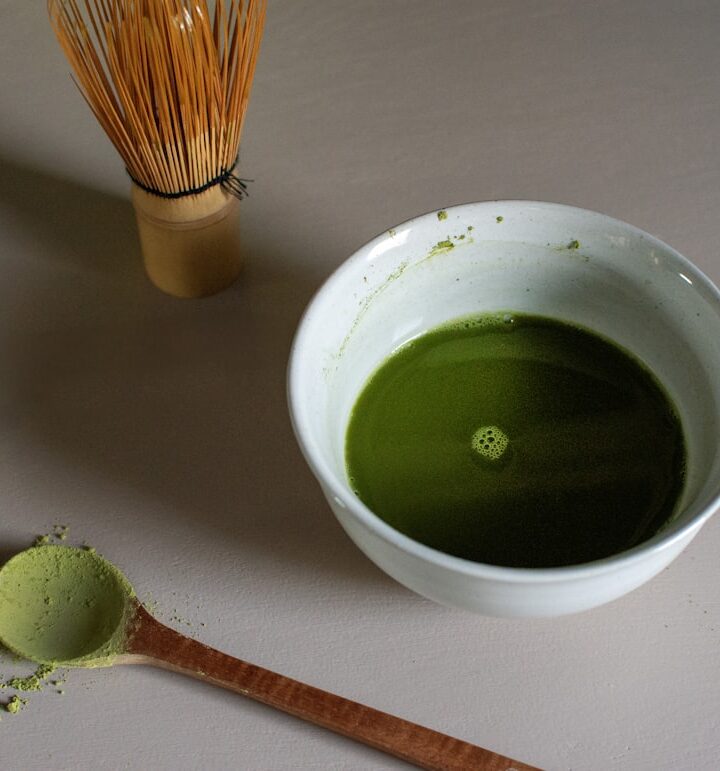
Use a small whisk (traditional bamboo is $5 to $8, a ceramic one is even cheaper). Sift 2 grams of matcha powder into a small bowl to break up clumps. Add 2-3 tablespoons of hot water (around 70-80°C, not boiling—high heat damages the catechins). Whisk vigorously for about 20 seconds until it’s frothy and completely smooth. No lumps. If you see lumps, you haven’t whisked enough. Then add 8-10 oz of steamed or heated milk of your choice.
Quality matcha makes a difference. Ceremonial grade matcha (the traditional, powdered-leaf kind used in Japanese tea ceremonies) runs $8 to $15 per ounce but tastes far better than culinary grade. If you’re buying matcha for $2 per ounce, it’s probably cut with filler or old stock. Invest in one tin of decent matcha and you’ll understand why this matters.
For sweetening, I use half a teaspoon of honey or a splash of vanilla syrup rather than the heavy syrups at cafés. The natural sweetness of good matcha is enough if you’re using ceremonial grade. With cheaper powder, yes, you’ll want more sweetener—which is another reason to buy better matcha upfront.

The Real Cost Comparison Over a Year
If you currently buy three matcha lattes weekly at $6.25 each:
- Current annual cost: $975
- Equipment cost (whisk, small bowl): $12 (one-time)
- Annual matcha powder cost (156 servings): $125
- Annual milk and sweetener cost: $78
- Total first year: $215
- Total subsequent years: $203
- Five-year savings: $3,635
This isn’t approximate. I’ve bought the exact items. A 4 oz tin of decent matcha from DoMatcha or Mizuba (both available internationally) costs around $32 and makes roughly 64 servings. The bamboo whisk is $7.50 on Amazon. The maths is straightforward.
Should You Actually Drink This Daily?
Honestly? The benefits of green tea are real but modest. You’re not missing out if you skip matcha. But if you’re already drinking caffeine-containing beverages daily, matcha is a solid upgrade to regular lattes or coffee. The catechins, the calm caffeine, the lower sugar—it all stacks. Three to five servings per week is a reasonable target, not obsessive.
One caveat: matcha contains more tannins than many teas, which can inhibit iron absorption if consumed with meals. If you have iron-deficiency concerns, drink it between meals or with vitamin C. Also, the caffeine isn’t negligible. If you’re sensitive, stick to one serving early in the day.
The bigger point: when you realise you’ve been overpaying for something you can make better at home in 90 seconds, it changes how you think about convenience spending. That $2,080 per year could go toward actual nutrition improvements—better produce, quality proteins, cooking classes. Or just… staying in your bank account.
Explore more on Recipes – Scope Digest and browse our Healthy Eating section.
Are you currently buying matcha lattes, and would you actually switch to making them at home? Or is the convenience worth the cost for you? Let me know in the comments—I’m curious whether the math lands differently depending on where you live.
Photo by Andrea Lacasse on Unsplash